ACWR: the endurance metric that predicts injury before it happens
Acute:chronic workload ratio compares your last 7 days of training against your last 28. Stay in the sweet spot and your injury risk stays low. Spike above it and you're rolling the dice.

Most running injuries aren't bad luck. They're visible weeks before they happen, in the training log.
ACWR — the Acute:Chronic Workload Ratio — is the clearest single number we have for catching them. It was popularized by Tim Gabbett's research on rugby and team-sports injury, and the signal replicates across endurance sports: running, cycling, triathlon, rowing. It's not perfect. It's just unusually useful for something that only requires division.
The formula
Take your acute load: total training in the last 7 days. Weekly mileage, time-based load (TRIMP), or session RPE × duration — any of these work, as long as you use the same metric consistently.
Take your chronic load: rolling average of the last 28 days.
Divide acute by chronic. That's your ratio.
- 0.8 to 1.3 — the sweet spot. You're training at roughly the same level as recent weeks. Adaptation without overreaching.
- Below 0.8 — detraining risk. You're losing fitness. Fine short-term (taper, recovery week) but a red flag if sustained.
- 1.3 to 1.5 — yellow zone. Manageable, but watch for soreness, sleep disturbance, small niggles.
- Above 1.5 — spike. Injury risk rises sharply. Gabbett's team found ratios above 1.5 correlated with a 2–4× injury rate across multiple studies.
Why it works
The principle is boring: your body adapts to the average workload it's seen recently, not to the single biggest week you've ever done. If you've averaged 40 km/week for a month and jump to 70 km the next, your ratio goes to 1.75 — and your tendons, bones, and connective tissue haven't had time to catch up. They're still built for 40.
Your cardiovascular system can handle the jump. Your lungs can. Your tissues can't. That gap is where calf strains, shin splints, Achilles tendinopathy, and stress fractures live.
The "spike trap" most runners fall into
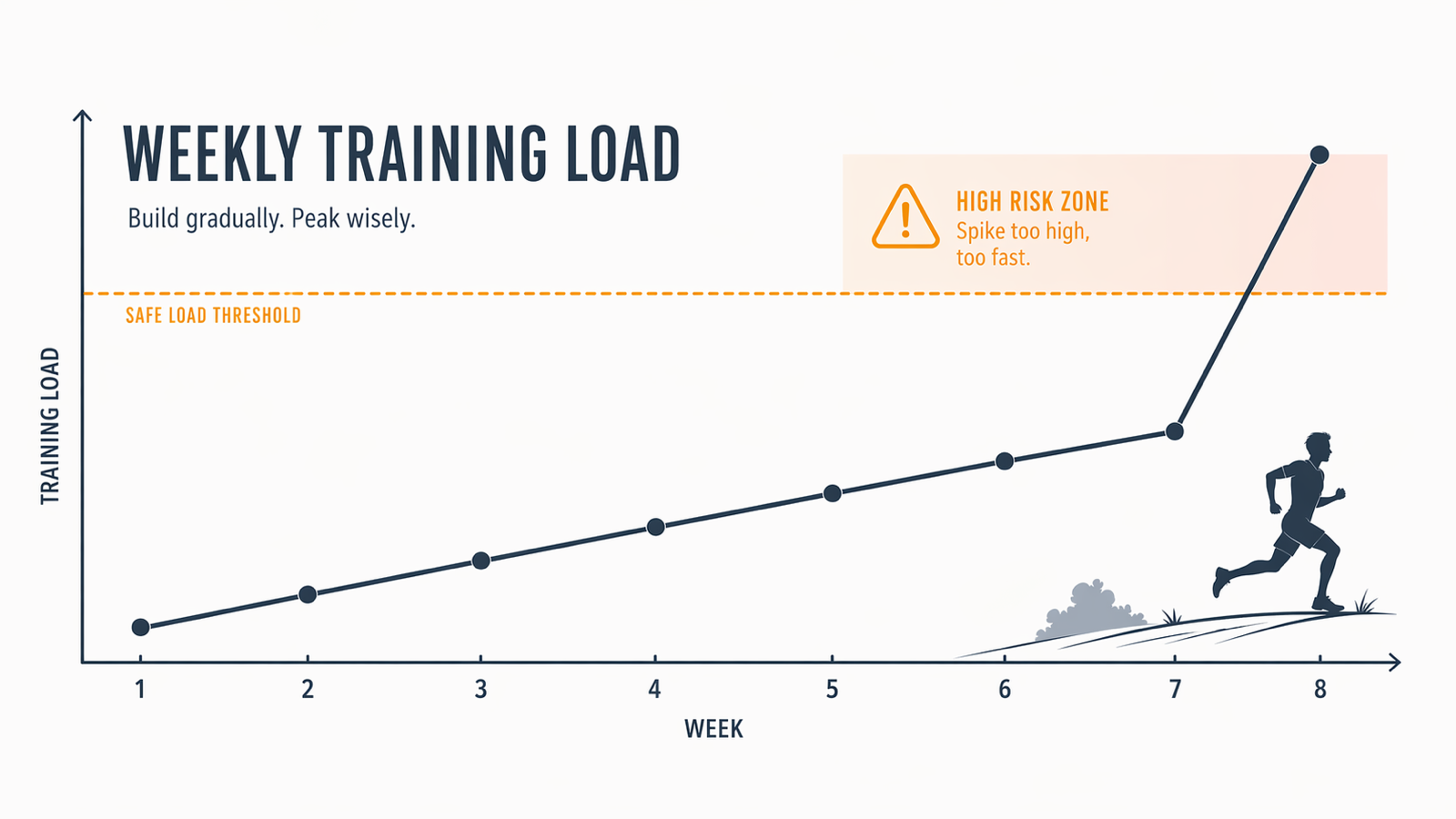
The classic spike isn't the race. It's the comeback.
You're sick for a week. You drop from 50 km to 10 km. Your chronic load ticks down slightly. Feeling better, you jump back to 50 — which now reads as 50/35 ≈ 1.4, right at the edge of the yellow zone. Push it to 60 that week "to catch up" and you're at 1.7. The injury that shows up two weeks later feels random. It wasn't.
Same pattern shows up after:
- Holiday travel
- Work crunches that killed midweek runs
- Minor injuries that cut training for 10 days
- "I feel great, let's do doubles this week"
How to use it as a planner, not a tracker
ACWR is most useful before the week, not after. Before planning next week's mileage:
- Look at your current chronic average (last 28 days).
- Multiply by 1.3. That's your cap for next week.
- If you want to go higher, plan the ramp: 1.1 this week, 1.15 next, 1.25 the week after — stair-stepping instead of leaping.
For events, plan the taper to gently dip acute load below chronic (ratio 0.7–0.9 the week before), bringing you fresh but not detrained.
Where it falls down
ACWR is a population-level signal, not a personal verdict. It doesn't know:
- Intensity mix. A 60 km week of easy running isn't the same stimulus as 40 km that includes two hard sessions. Use a weighted metric (TRIMP, sRPE × duration) if you care about this.
- Individual history. A runner with 10 years of high-volume training tolerates higher ratios than a 6-months-in beginner.
- The rest of your life. Sleep, stress, and strength work don't show up in running load.
Treat it as one lane marker among several, not a lane itself. But when your ratio is 1.7 and your calf is twinging, that's not coincidence.