RIR beats 1RM percentages for real-world lifting
Percentage-based strength programs assume a stable 1RM. Your 1RM isn't stable — it moves every week with sleep, stress, and accumulated fatigue. RIR auto-regulates to what you actually have today.

If you've trained seriously for a few years, you already know this on some level: the same bar weight doesn't feel the same every week. The day you do 5×5 at 80% and fly through it. The day you do 5×5 at 80% and the last set is a grind you'll remember in your lower back for three days. Same program. Same weight. Completely different stimulus.
This is the problem with percentage-based programming: it assumes your maximum is a fixed point. It isn't. Your 1RM is a moving target that drifts with sleep, nutrition, stress, phase of training, and whatever happened on Tuesday. By the time your program re-tests a max, it's lying to you for four to eight weeks.
RIR — Reps in Reserve — fixes this by replacing the percentage with a question.
What RIR actually is
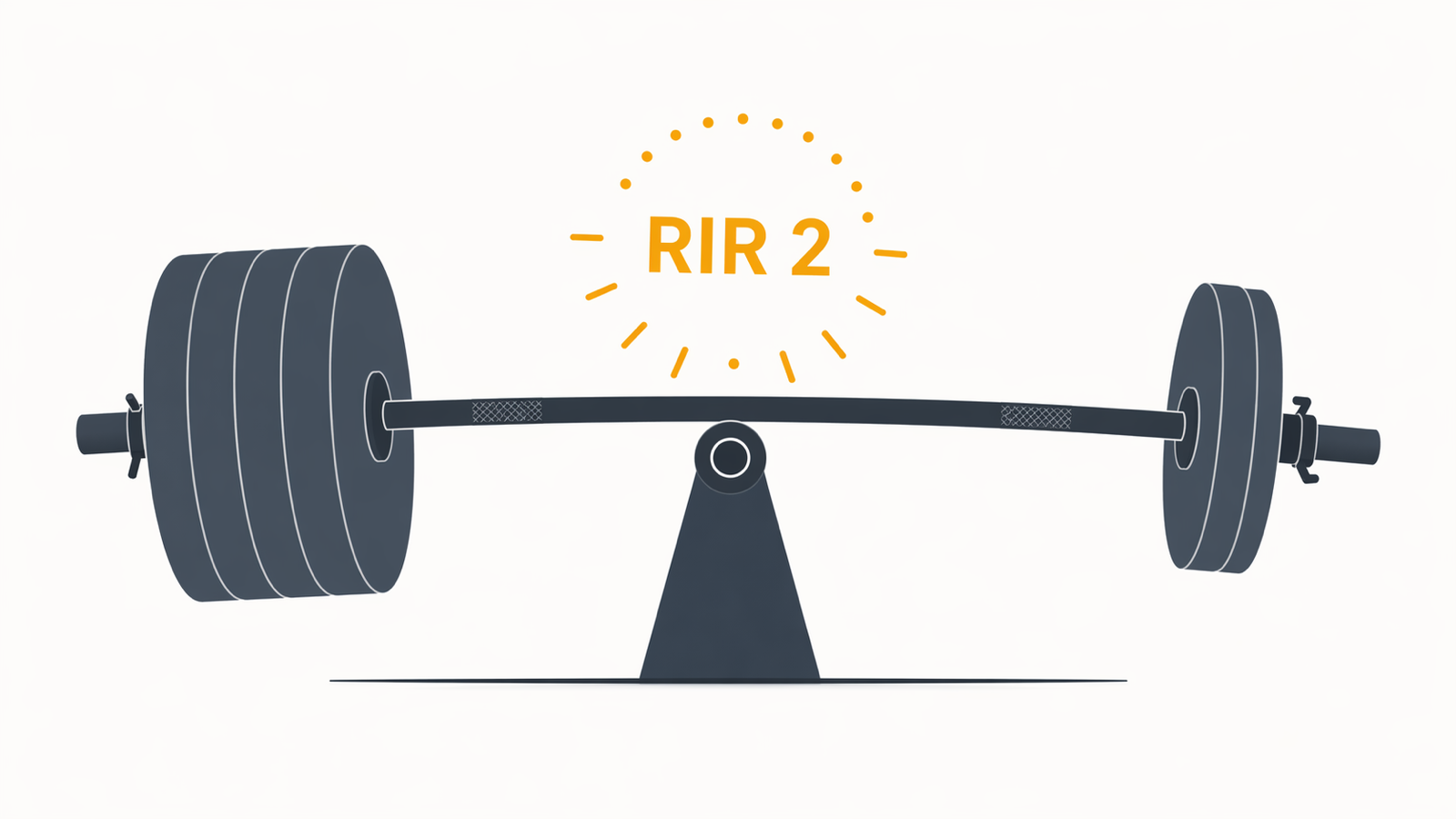
RIR is how many more reps you could have done with good form at the end of a set. RIR 0 is failure. RIR 1 means you had one more clean rep in the tank. RIR 3 means three.
Instead of "5 reps at 80%," a set is prescribed as "5 reps at RIR 2." The weight you use is whatever hits RIR 2 today. Some days that's 82% of your theoretical max. Some days it's 74%. The intensity is what gets auto-regulated.
The number of reps and the target RIR stay fixed. The weight bends around them.
Why it works better
Three things happen when you lift this way:
- Fatigue is managed by design. If you're wrecked, the weight drops automatically — you can't hit RIR 2 at last week's load, so you go lighter. No missed reps, no burnout.
- Progress becomes a ratchet, not a test. When the weight at RIR 2 goes up, that's real progress. No re-testing a 1RM, no deload just to verify the number.
- You stay honest about effort. "I hit the prescribed reps" tells you nothing about how hard it was. "RIR 2" tells you exactly that.
The calibration problem
RIR is only useful if you can read it. Most lifters overestimate RIR by 1–2 reps until they've taken sets to actual failure a few times. If you think the last set was RIR 1, but you'd have stopped at rep 1 of a hypothetical extra rep — it wasn't RIR 1.
Calibrating is a specific practice:
- Every 4–6 weeks, take one main lift to true failure on your last set.
- Note how many reps you actually got.
- Compare to what your second-to-last set felt like. If you said "RIR 2" on that set and then went 4 more on the next, you were at RIR 4.
- Adjust your internal scale.
Most people need two or three cycles of this before their RIR estimates become trustworthy. That's fine. The skill pays off forever.
When percentages still work
None of this means you ditch percentages. They're still the right tool for:
- Peaking for a meet or test day, where predictability matters more than auto-regulation.
- Programming for beginners, who don't yet have the proprioception to read RIR reliably.
- Low-rep power work, where RIR gets fuzzy — is RIR 3 on a single even meaningful?
For everything else — hypertrophy, accessories, general strength work, especially when you can't train in a vacuum because you also run, cycle, or have a life — RIR is the better tool. It respects the fact that you're a human being, not a lab animal on a fixed load chart.