Deloads aren't vacations. They're how you keep making gains.
A deload week isn't a break from training — it's the structured light week that lets the hard weeks stay hard. Planned deloads prevent reactive ones. Here's the difference.

Ask ten self-directed lifters how they handle deloads and you'll get three answers: "I deload when I feel fried," "I don't, I just train," and "I do a light week every four weeks." Only the third one has a real chance of working long-term.
The first two are the same mistake wearing different clothes. One person deloads when they're already cooked — which is too late. The other refuses to deload at all — and their training stays fine for 8–12 weeks before the progress stalls or something hurts.
A planned deload is a specific, structured light week you schedule before you need it. It's not a rest week. It's not skipping workouts. It's a calibrated reduction in training stress, positioned to let accumulated fatigue dissipate while preserving the adaptations you built.
Why it works
Training gains sit on a fatigue-fitness curve. Fitness builds slowly over weeks. Fatigue accumulates faster. Performance — what you can actually do on a given day — is fitness minus fatigue.
If you train hard for six weeks straight, your fitness is up, but your fatigue is up more. Performance drops. You interpret that as "plateau" and push harder, which makes fatigue worse, which makes performance worse. This is how self-directed lifters end up with six months of no visible progress despite training more than ever.
A deload week cuts training stress by 30–50% for 5–7 days. Fatigue drops fast. Fitness drops barely at all (aerobic and strength adaptations don't disappear in a week). When you resume the next hard block, performance is higher than it was before — not because you got stronger in the deload, but because you stopped masking the strength you already had.
What a deload actually looks like
The specifics depend on your training, but the common shapes:
- Volume deload: same weights and exercises, cut sets by 30–50%. 3×5 becomes 2×5 or 1×5. Most useful after high-volume hypertrophy blocks.
- Intensity deload: same volume, weights cut to roughly 60–70% of normal working load. Most useful after high-intensity strength blocks where your bar weight has climbed.
- Frequency deload: drop one or two training days from the week, keep the remaining sessions normal. Simpler for runners who can just cut a midweek session.
- Full reset: rare — used maybe twice a year after a major event or a long block. 50% volume AND 50% intensity for a week.
Endurance-specific: cut weekly mileage by 30%, drop the hardest quality session, keep some easy running to maintain aerobic base. Don't go to zero — that's a taper, not a deload, and they serve different purposes.
When to deload
Rules of thumb, roughly in order of reliability:
- Every 4–6 weeks of hard training. This is the pre-emptive approach. Most effective, least dramatic.
- When you miss reps or pace targets two sessions in a row on lifts/runs that were previously easy.
- When your session RPE is consistently 1–2 points higher for the same work over a week.
- When HRV drops for 5+ days in a way that doesn't match life stress.
- When sleep quality drops despite unchanged sleep quantity — a sign of overreaching.
Don't wait for all five. If two stack up at the same time, deload now. You'll lose a week of hard training and get back two weeks of progress on the other side.
The mindset shift
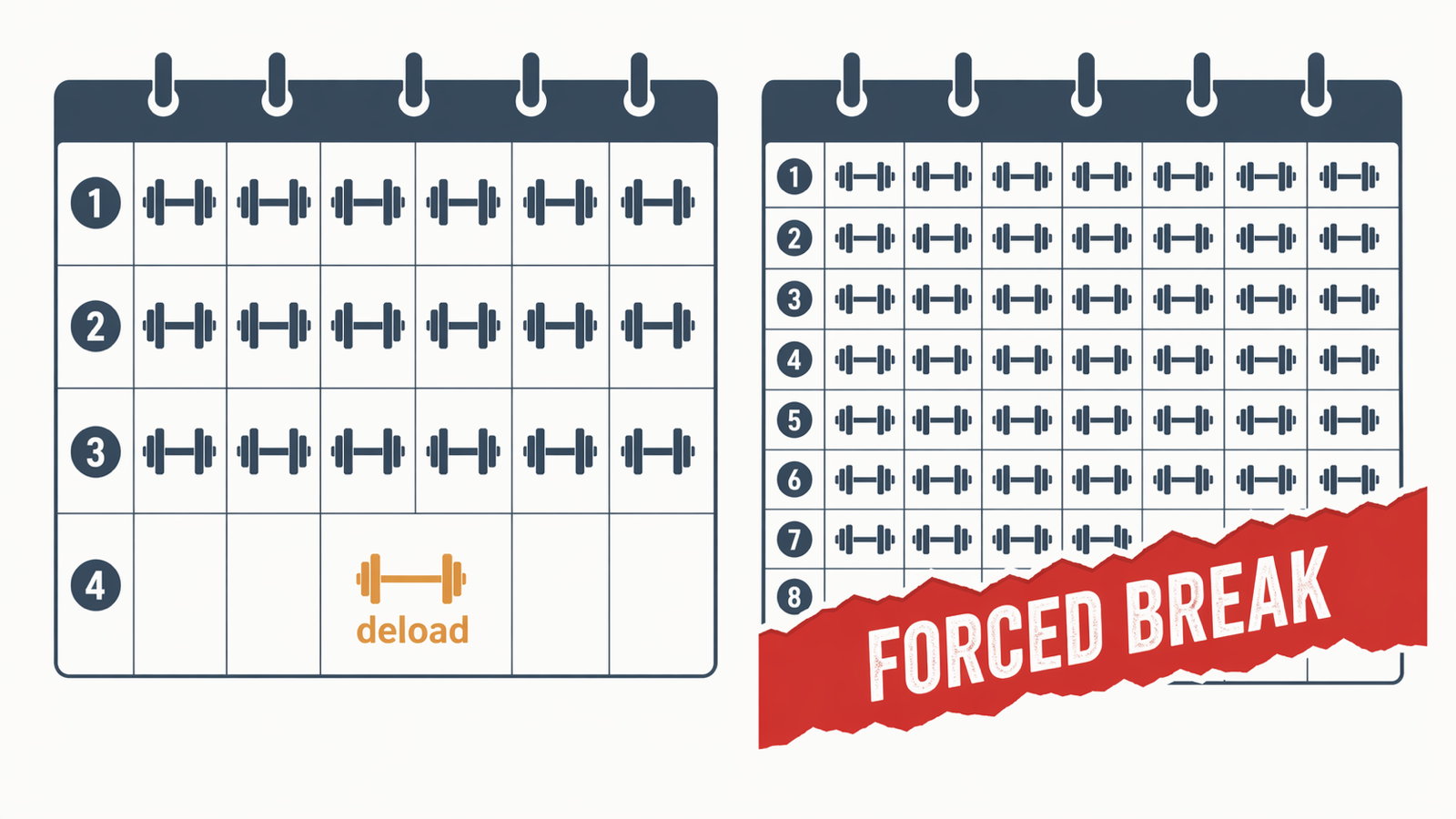
Lifters and runners who plateau usually plateau not because their plan is wrong but because they refuse to let it include deloads. Hard weeks are only hard when the baseline is recovery. Remove the recovery and the hard weeks become the baseline — which is just chronic fatigue wearing a planner's outfit.
The athletes who keep progressing into their thirties, forties, fifties all share one habit: they deload before they need to. The ones who burn out skip deloads because "I feel fine" — and they're correct, until suddenly they're not.
Schedule the light weeks. Then actually do them light.