Why is one side stronger than the other?
Almost everyone has one side a little stronger. Here is why it happens, what the research says about the risk, and how to train and log each side so the weaker one catches up.Almost everyone has one side that is a little stronger. You use one hand more, you kick with one leg, and in a barbell lift the stronger side quietly does more of the work. A small gap is normal and is not a sign that something is wrong. A gap that keeps growing, or one that comes with pain, is worth a closer look.
The fix is not complicated: train each side on its own for part of your program, start with the weaker side, and let each side move up when it has earned it.
Why one side gets ahead
- You use it more. Your dominant hand carries bags, opens doors and throws. Your dominant leg kicks and pushes off. Years of that add up.
- Your sport. Tennis, padel, football and throwing sports load one side far more than the other.
- An old injury. A sprained ankle or a sore shoulder makes you protect that side for weeks. The muscle around it loses strength and does not always come back on its own.
- Bilateral lifts hide it. In a squat or a bench press with a barbell, both sides share one bar. The stronger side can take a bit more of the load, and the bar still goes up.
Is it a problem?
Less than the internet suggests. A review of 18 studies found that a strength gap between the legs may hold back jumping, kicking and cycling (Bishop et al., 2018). But every study in it only measured a link. None of them tested whether closing the gap improves performance.
Injury is even less clear. A review of 31 studies on the legs asked whether a gap between sides makes injury more likely (Helme et al., 2021). Eight studies found no link, ten found a partial link and ten found a clear one. The authors rated the evidence as moderate to low quality, partly because each study measured the gap in a different way.
So a gap is not a diagnosis. It is a reason to train both sides well, and a number worth watching.
Single-arm and single-leg work is the tool
Training one side at a time takes away the place to hide. A meta-analysis of 9 studies compared unilateral training (one arm or one leg) with bilateral training (both together) (Kassiano et al., 2025):
- Muscle growth was similar with both.
- Strength followed what you trained. Bilateral training raised two-sided strength more. Unilateral training raised one-sided strength more.
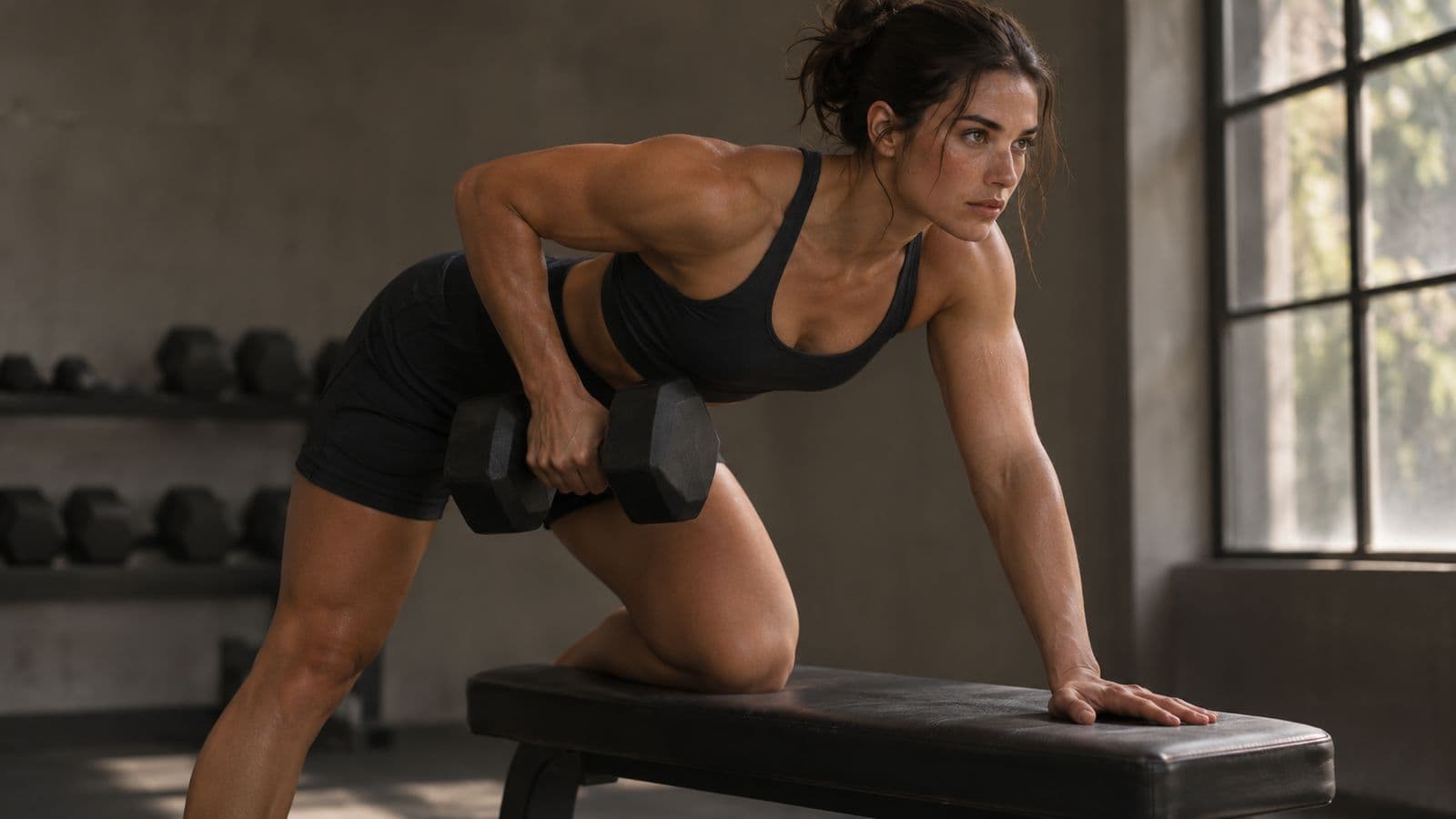
So you don't have to give up the squat or the bench press. Keep them, and add one or two single-side exercises: a single-arm dumbbell row or press, a Bulgarian split squat, a single-leg Romanian deadlift, a step-up.
How to train the weaker side
- Start with the weaker side. You are freshest on the first side, so give that to the side that needs it.
- Pick a weight both sides can do with good form. If the strong side flies through 12 reps and the weak side grinds 8, the weight is right for neither. Use the weight the weaker side can handle cleanly, or give each side its own.
- Let each side progress on its own. Use the same rule for both, such as double progression: when a side reaches the top of the rep range on every set, that side goes up. The other side waits until it gets there too.
- Keep the effort the same. Stop both sides at the same reps in reserve. Otherwise you are comparing an easy set with a hard one.
- Rest between sides if you need it. On a heavy split squat, the second leg is working tired. A short pause before the second side makes it a fair test.
Many coaches also add one extra set for the weaker side for a few weeks. That is a reasonable thing to try, but there is little research on it, so watch your numbers to see if it helps you.
If one side is injured, train the other
Training one side also makes the other side a bit stronger. This is called cross-education. A meta-analysis of 31 studies and 785 people found that the untrained side gained about 12% strength on average when only the other side was trained (Manca et al., 2017). The gain was about 16% in the legs and 9% in the arms.
That does not replace training the injured side. But if a physio has told you to rest an arm or a leg, training the healthy one helps you keep some strength on the resting side. Ask your physio before you train around an injury.
When to see someone
See a physio or a doctor if the gap appeared suddenly, if it comes with pain, numbness or tingling, or if it keeps growing even though you train both sides. Those are not training problems.
Log each side, not the average
Here is where most logs go wrong. You did 24 kg on the left and 26 kg on the right, and the log saves one number. If it saves 25, neither side is right. If it saves 26, the left side looks stronger than it is.
Peak Health keeps the two sides apart: Left 24×8 / Right 26×8, not a 25. Last time sits next to the set you are on, on the side you are on. If the right side earns its increase and the left does not, only the right goes up. Logging each side apart is free. Writing the sides into a routine, with the sets per side, the order and the rest, is part of Premium. See how per-side tracking works.
The short version
- A small strength gap between sides is normal.
- The research links bigger gaps with some performance measures, and the link with injury is mixed.
- Add single-arm and single-leg exercises, and keep your two-sided lifts.
- Start with the weaker side, keep the effort the same, and let each side progress on its own.
- Log left and right apart. An average hides the gap you are trying to close.